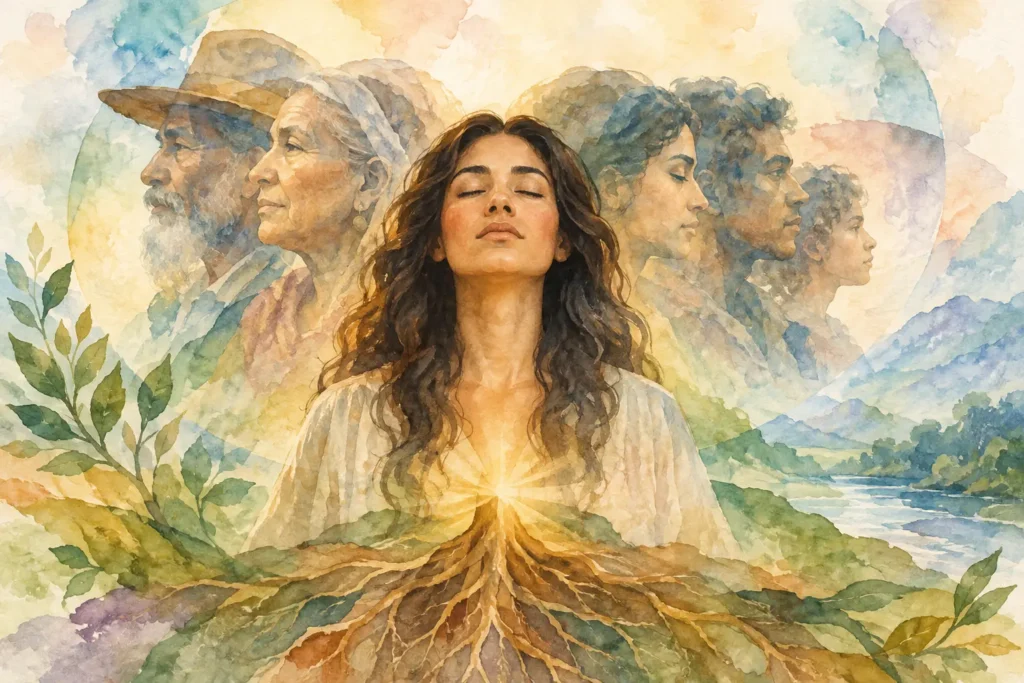
Some patterns feel older than the story you can tell about them. You may know you are worthy of love, yet find yourself bracing for rejection. You may long to create a family, speak your truth, rest without guilt, or receive support, but something in your body tightens each time you move closer. Learning how ancestral healing works can offer a compassionate lens for understanding these deeply rooted experiences – not as personal failures, but as patterns that may have traveled through generations.
Ancestral healing is a soul-centered process of bringing awareness, care, and healing intention to the emotional, relational, and energetic inheritances of your family line. It invites you to honor what your ancestors endured while choosing what you no longer wish to carry. The goal is not to blame your family or rewrite history. It is to meet the past with reverence, release what is ready to shift, and create more freedom in the life you are living now.
How ancestral healing works at the root
Every family carries stories. Some are spoken openly, while others live in silence: migration, loss, poverty, addiction, illness, violence, secrecy, estrangement, discrimination, or the pressure to survive at all costs. Even when we did not personally experience these events, their emotional impact can shape family beliefs, parenting styles, nervous-system responses, and relationship patterns.
From a therapeutic perspective, children learn through attachment, observation, and repetition. If love was inconsistent, if emotions were not safe to express, or if women in a family were taught to silence their needs, those lessons can become unconscious rules. From an energetic and spiritual perspective, many people also experience ancestral patterns as inherited imprints held in the body, heart, and lineage.
Ancestral healing works by gently making these patterns visible. Through conversation, intuitive guidance, somatic awareness, energy work, ritual, and intentional reflection, a practitioner helps you identify what may be yours to feel and what may have been passed down. Naming a pattern does not automatically erase it. But awareness creates a sacred pause between the old conditioning and your next choice.
The process is not about carrying more pain
A common fear is that ancestral work means digging endlessly into family trauma or taking responsibility for the healing of everyone who came before you. It does not. You are not here to rescue your ancestors, excuse harmful behavior, or absorb stories that do not belong to you.
Instead, this work can help you establish loving boundaries with the past. You may acknowledge, for example, that a grandmother’s hypervigilance helped her survive, while recognizing that you no longer want fear to make every decision in your life. You can hold compassion for the conditions that shaped your parents and still grieve what you did not receive.
For some people, healing begins with family history and clear memories. For others, it begins with a sensation: a heaviness in the chest when receiving money, a wave of guilt when setting a boundary, or an unexplained fear around pregnancy, visibility, or belonging. The body often carries wisdom before the mind has language for it.
What may arise in a session
Because each healing journey is personal, no two sessions look the same. A supported ancestral healing process may include identifying repeated family themes, noticing emotional or physical responses, exploring beliefs learned in childhood, and creating new practices that reinforce safety and self-trust.
Intuitive and energetic approaches may also bring forward images, symbols, emotions, or felt senses connected to lineage. These experiences are best held as meaningful invitations for reflection, not as unquestionable historical fact. A skilled practitioner remains grounded, helps you stay connected to your present-day reality, and supports you in choosing what resonates without forcing an interpretation.
At Love Evolution, this kind of multidimensional care can make room for the emotional, mental, physical, energetic, spiritual, and ancestral layers of a pattern. The work is paced according to your readiness, with space for integration rather than pressure to have a breakthrough on demand.
Signs an inherited pattern may be asking for care
There is no test that proves a challenge is ancestral. Often, it is a sense that a pattern is persistent, disproportionate, or difficult to change through insight alone. You may notice recurring relationship dynamics, a family-wide fear of success, chronic people-pleasing, shame around the body or sexuality, difficulty receiving abundance, or a belief that struggle is the only path to safety.
Fertility and reproductive experiences can be especially tender places for ancestral exploration. Family stories about miscarriage, childbirth trauma, loss, silence, or expectations around motherhood may shape the emotions a person carries. Ancestral healing should never suggest that someone caused their health condition or fertility challenge through spiritual blocks. It can, however, offer caring support for the grief, fear, and inherited narratives that may be present alongside appropriate medical care.
The same discernment matters with trauma. Ancestral healing can complement therapy and other forms of support, but it is not a replacement for trauma-informed mental health treatment, medical care, or crisis support. If you are experiencing severe anxiety, depression, dissociation, or thoughts of harming yourself, seek qualified clinical or emergency help right away.
Releasing a pattern means practicing a new relationship with life
A profound session can open a door, but lasting transformation happens through what follows. If you recognize an inherited belief such as, “My needs are a burden,” the healing continues as you practice asking for help, resting before burnout, and allowing care to reach you. Your nervous system needs repeated evidence that a new choice is safe.
Integration may be quiet and practical. You might journal about the values you want to carry forward, create a small ritual of gratitude for the strengths in your lineage, speak a boundary aloud, or place a hand on your heart when an old fear rises. These actions are not meant to be perfect. They are ways of returning to yourself with consistency.
It can also help to distinguish honoring from repeating. You can honor the resilience of the women who came before you without inheriting their self-abandonment. You can appreciate a family’s work ethic without sacrificing your health to prove your worth. This is where ancestral healing becomes deeply empowering: you are not rejecting where you come from. You are allowing the lineage to evolve through your conscious choices.
What to look for in ancestral healing support
This work asks for tenderness and discernment. Choose a practitioner who respects your beliefs, culture, and family complexity rather than making sweeping claims about your lineage. They should never pressure you to forgive before you are ready, insist that every struggle has an ancestral cause, or position themselves as the sole authority over your experience.
A supportive guide helps you stay present, empowered, and connected to your own inner knowing. They welcome practical questions, encourage integration, and understand when a referral to a licensed mental health or medical professional is needed. If you come from an Indigenous, diasporic, or specific cultural tradition, it may also be meaningful to seek teachers and practices that are rooted in and accountable to that tradition.
You do not need to know every name, date, or family story to begin. You only need a willingness to meet what is arising with curiosity and compassion. Sometimes healing starts with a simple truth: what you have carried has made sense, and you are allowed to choose a lighter way forward.